
When I first read the closing verses of Abraham’s story in Genesis 25, one number stood out to me: 175. It is a surprisingly specific figure for a man who lived roughly four thousand years ago.
In this article, we will see how old Abraham was when he died, where he was buried, and what the Bible tells us about his 175 years of life.
Short Answer: Abraham Was 175 Years Old
Abraham was 175 years old when he died. Genesis 25:7 says, “And these are the days of the years of Abraham’s life which he lived, an hundred threescore and fifteen years.”
The old English words can be hard to understand. “Threescore” means sixty, so “an hundred threescore and fifteen” means 100 + 60 + 15, which is 175 years.
The very next verse adds a beautiful detail about how he died:
“Then Abraham gave up the ghost, and died in a good old age, an old man, and full of years; and was gathered to his people.” (Genesis 25:8, KJV)
Three phrases in that single verse tell us a lot. He died at “a good old age.” He was “full of years.” And he “was gathered to his people.”
Abraham and Keturah: What the Bible Reveals About Their Marriage
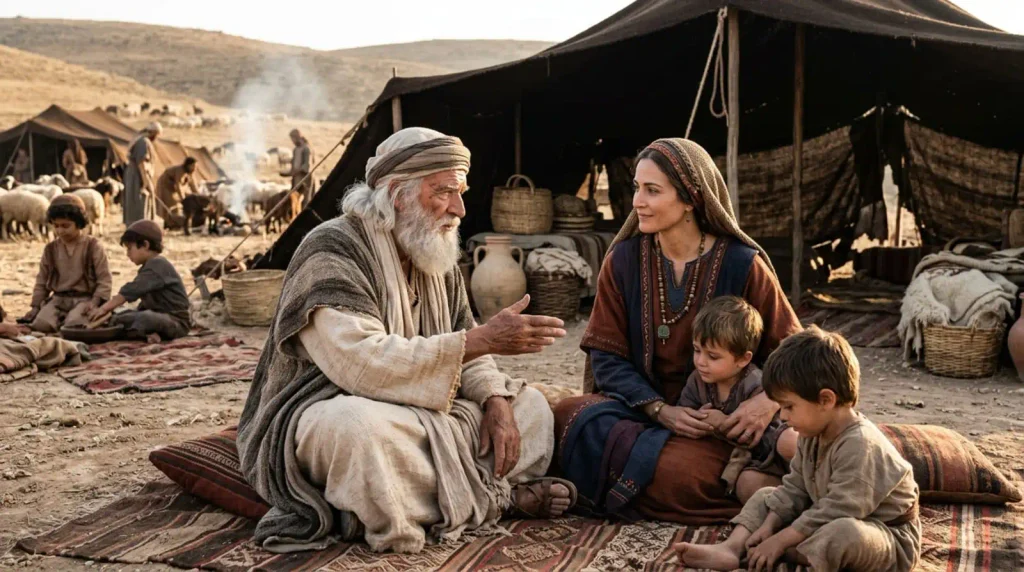
Sarah’s death left Abraham a widower at about 137, and Genesis 25:1 reveals a surprising detail about his final decades: “Then again Abraham took a wife, and her name is Keturah.” The verse opens the same chapter that records his death at 175, which places this marriage somewhere in his late 130s or later — the Bible never gives the exact year.
Keturah bore Abraham six sons, including Midian, whose descendants later play a significant role in the story of Israel. Yet Abraham did not treat these sons as rivals to the covenant heir. Genesis 25:6 says he gave them gifts and, “while he yet lived, sent them away from Isaac his son, eastward” — a deliberate act to keep the line of promise uncluttered before his death.
Jewish tradition adds an intriguing debate: some ancient commentators, following Rashi, identified Keturah with Hagar, though Genesis presents her as a distinct person and most Christian scholars read her as a second marriage after Sarah’s death. In either case, the passage portrays Abraham as someone who continued to make thoughtful arrangements for his family’s future throughout his long life of 175 years.
How Old Was Abraham When Jacob and Esau Were Born?
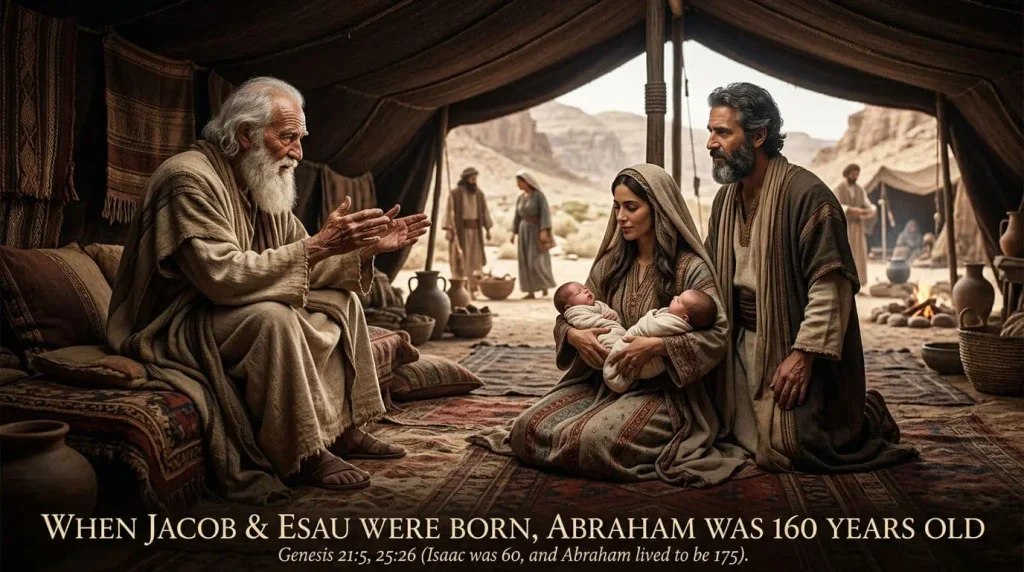
Abraham lived long enough to hold his most famous grandchildren in his own arms. Isaac was 60 years old when the twins Jacob and Esau were born (Genesis 25:26), and since Abraham was 100 at Isaac’s birth (Genesis 21:5), the math places Abraham at 160 years old when Jacob and Esau arrived.
That means the patriarch who received the promise of countless descendants spent his final 15 years in the same household as the grandsons who would carry it — Jacob, later renamed Israel, and Esau, father of the Edomites. Abraham died at 175 when the twins were only teenagers, so he never saw who they would become.
Scripture does not record any conversation between Abraham and the boys, and honest readers should resist inventing scenes the Bible leaves silent. What the timeline does confirm is remarkable on its own: the man called at 75 to father a nation lived to see three generations of that family gathered under his own roof.
When Did Abraham Live? Placing His 175 Years in History
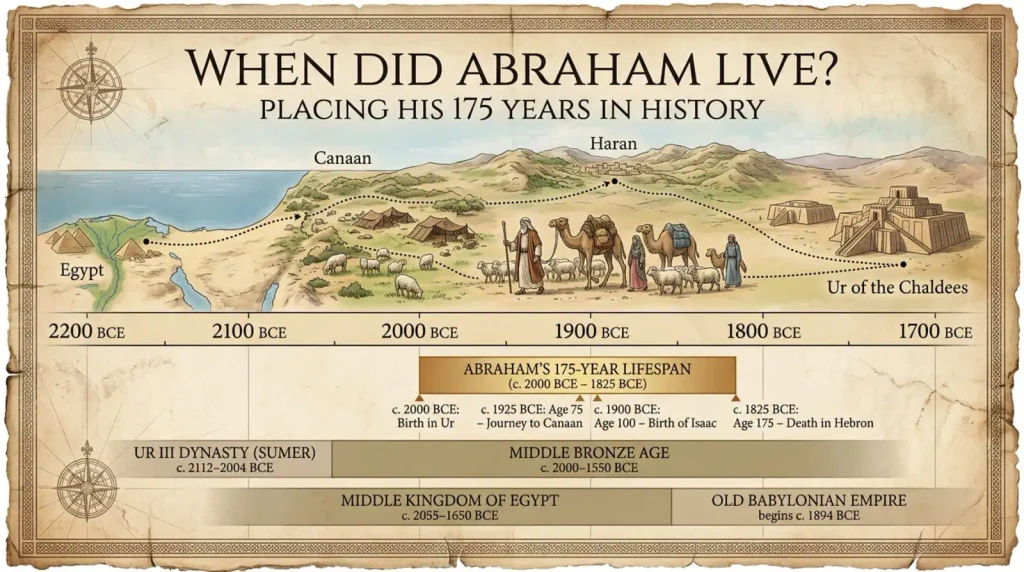
The Bible records Abraham’s age in years but not in calendar dates, so historians construct his era by working backward through the genealogies of Genesis 11 and the chronological clues woven into Genesis 12–25. On the most widely used timeline, Abraham was born around 2166 BC and died around 1991 BC, though scholars caution that these dates are approximations built on a chain of ages rather than fixed calendar records.
Those two centuries place him in the Middle Bronze Age — the world of city-states like Ur, caravan trade routes, and the early Canaanite kingdoms. It fits the Genesis portrait of a man who left an urban center for a nomadic life among wells, tents, and altars.
For readers comparing lifespans, the dates matter less than the pattern they reveal: Abraham’s 175 years bridge the era when long lifespans were normal and the era when his descendants would live much shorter lives. His century in Canaan covers nearly half of the Bible’s own recorded timeline for him.
Who Buried Abraham, and Where Is He Buried?
Genesis does not close Abraham’s account at the tomb. The very next verse shifts attention to the heir: “And it came to pass after the death of Abraham, that God blessed his son Isaac; and Isaac dwelt by the well Lahairoi” (Genesis 25:11, KJV). The blessing that had defined Abraham’s life passed, by God’s own act, to the son of promise.
The chapter has already explained the estate arrangement. Abraham gave everything he owned to Isaac, while the sons of Keturah received gifts and were settled eastward away from him (Genesis 25:5–6) — a clear, public, and peaceful transfer that prevented any inheritance dispute.
Then Genesis adds one quiet chronology before moving on: Ishmael lived to 137 and died in the presence of his brethren (Genesis 25:17). Within a handful of verses, the Bible settles the inheritance, blesses the new generation, and closes the records of both firstborn and promised sons. Abraham’s death at 175 was not an ending so much as an orderly handover of God’s covenant story.
What Does “Gathered to His People” Mean?
That final phrase is worth pausing on. It does not simply mean that Abraham died. The same expression is used for Ishmael a few verses later (Genesis 25:17) and for Isaac in Genesis 35:29.
Most Bible readers understand it in two layers. On the surface, it describes death itself joining the family members who went before him.
But many people see a deeper meaning in these words. They point to life after death, where being apart is not the end.
Abraham lived his life trusting God’s promise that he would be the father of many nations. So, his death was not seen as a defeat. It was like going home to be with God.
Where Was Abraham Buried?
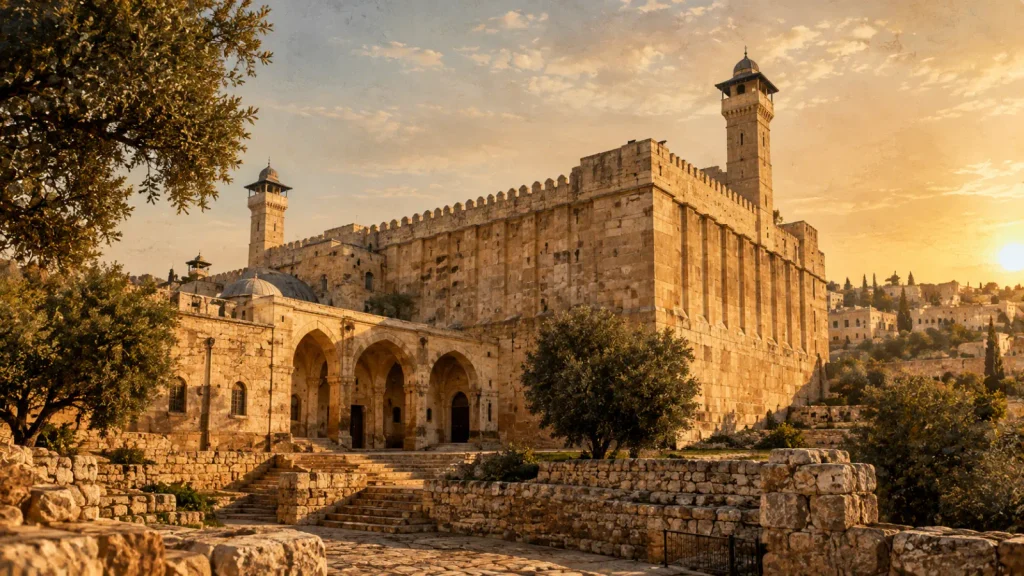
Genesis 25:9 gives the answer:
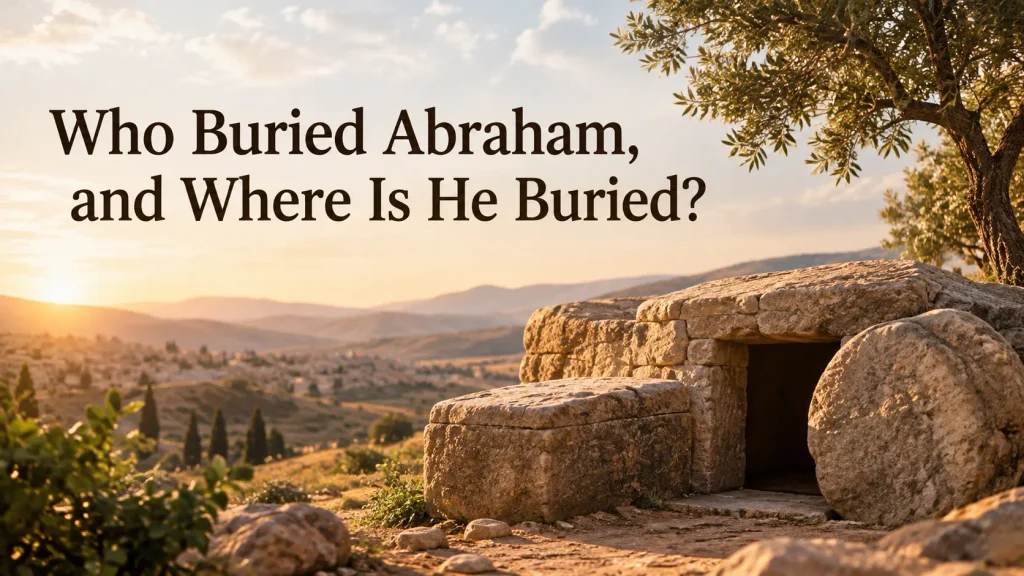
“And his sons Isaac and Ishmael buried him in the cave of Machpelah, in the field of Ephron the son of Zohar the Hittite, which is before Mamre.” (Genesis 25:9, KJV)
Two details make this burial significant.
First, the sons who buried him. Isaac and Ishmael buried their father together. These two brothers had a complicated history Isaac was the child of promise, and Ishmael had been sent away years earlier.
Yet at Abraham’s death, they stood side by side at the cave.
Second, the place itself. Genesis 25:10 says, “The field which Abraham purchased of the sons of Heth: there was Abraham buried, and Sarah his wife.
” This was not borrowed ground. Abraham had legally bought the field and the cave at Machpelah, near Mamre (Hebron), years earlier as a family burial place.
It is the only piece of the promised land Abraham ever owned and he purchased it at full price: “four hundred shekels of silver, current money with the merchant” (Genesis 23:16, KJV).
Abraham died without owning the land God promised him, yet he was buried in the one field that was truly his. To me, that quiet detail carries the weight of the whole promise.
Abraham’s Life at a Glance (Timeline Table)
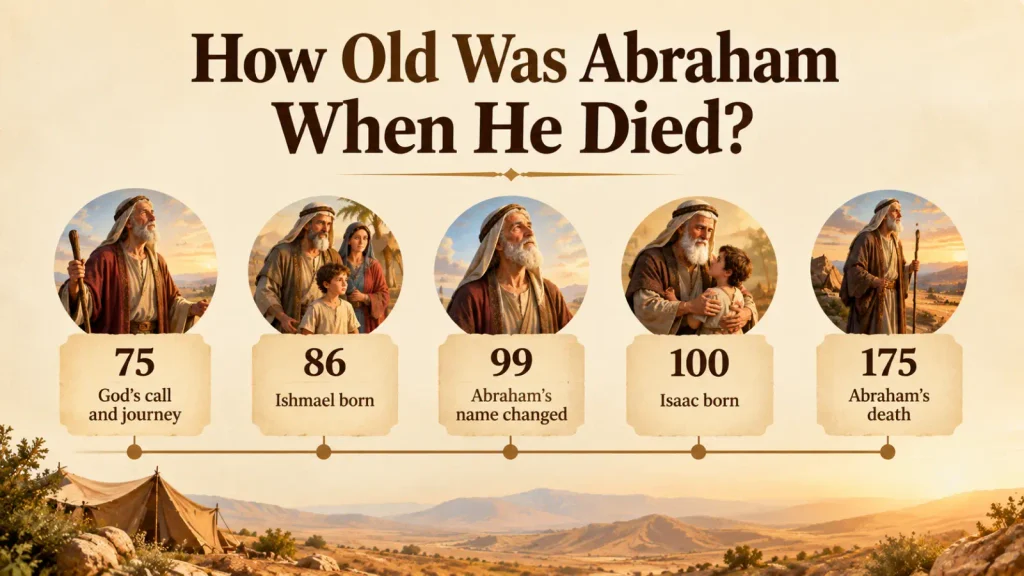
Genesis records Abraham’s age at almost every turning point of his life. Put together, the numbers tell the story of a man who waited on God for decades:
| Event | Abraham’s Age | Bible Reference |
|---|---|---|
| God calls him to leave Haran | 75 | Genesis 12:4 |
| Ishmael is born | 86 | Genesis 16:16 |
| His name is changed from Abram to Abraham | 99 | Genesis 17:5 |
| God promises a son through Sarah | 100 (Sarah is 90) | Genesis 17:17 |
| Isaac is born | 100 | Genesis 21:5 |
| Sarah dies | about 137 (Sarah was 127) | Genesis 23:1–2 |
| Abraham dies | 175 | Genesis 25:7 |
A few of these ages deserve a closer look.
He left everything at 75. “And Abram was seventy and five years old when he departed out of Haran” (Genesis 12:4, KJV).
Most people plan their retirement at 75. Abraham started the greatest journey of his life at that age.
He waited 25 years for the promised son.
From the call at 75 to Isaac’s birth at 100, a quarter of a century passed. “And Abraham was an hundred years old, when his son Isaac was born unto him” (Genesis 21:5, KJV).
When God first announced it, Abraham himself could hardly believe it: “Shall a child be born unto him that is an hundred years old? and shall Sarah, that is ninety years old, bear?” (Genesis 17:17, KJV).
He lived 48 years after Sarah died.
Sarah was 127 when she died in Kirjatharba, the same as Hebron (Genesis 23:1–2). Since Abraham died at 175, he lived another 48 years after losing his wife long enough to see Isaac married with children.
How Old Was Abraham at Key Moments of His Life?
Reading the numbers side by side changes how the story feels:
- At 75, he obeyed a call he could not fully see.
- At 86, he took matters into his own hands, and Ishmael was born.
- At 99, God reaffirmed the covenant and gave him a new name “for a father of many nations have I made thee” (Genesis 17:5, KJV).
- At 100, he held the son God had promised.
- At 175, he died full of years, with the promise still growing beyond him.
Notice the pattern: Abraham’s greatest act of faith came at 75, his biggest failure around 86, and his greatest joy at 100.
God was not finished with him in his old age some of the most important chapters came after most people would have retired.
How Does Abraham’s Age Compare With Other Patriarchs?
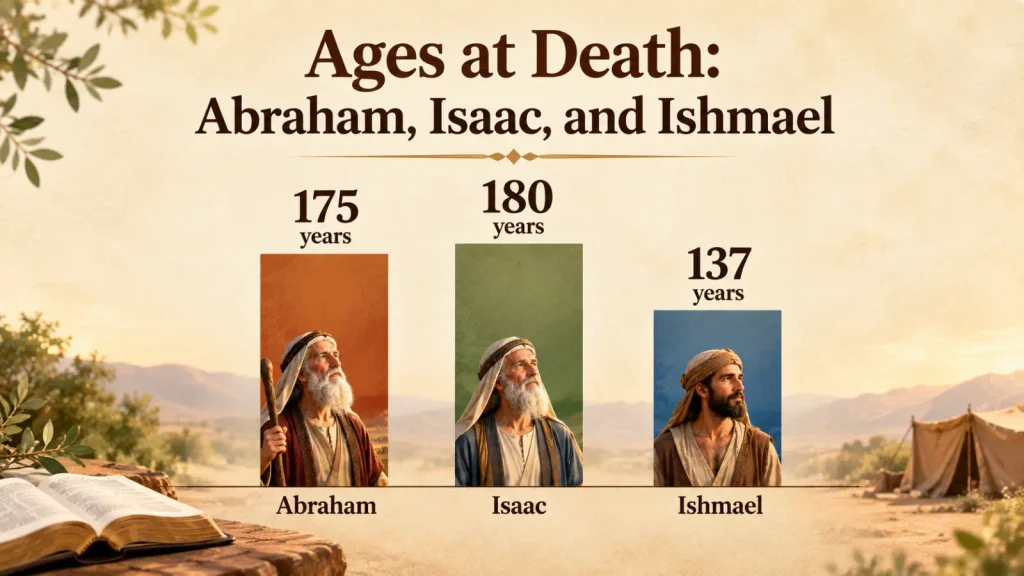
| Patriarch | Age at Death | Bible Reference |
|---|---|---|
| Ishmael | 137 | Genesis 25:17 |
| Abraham | 175 | Genesis 25:7 |
| Isaac | 180 | Genesis 35:28–29 |
Did Abraham Really Live 175 Years?
Some readers find the age of 175 hard to understand. Some scholars also have questions about the family timeline, such as how Abraham’s age fits with his father Terah’s age when Abraham was born.
These are honest questions about the Bible’s numbers, and it is okay to talk about them.
But the Bible’s own statement is not ambiguous. Genesis 25:7 fixes the length of Abraham’s life at 175 years, and Genesis does not treat it as symbolism.
The number may be hard for some people to believe, but the Bible clearly gives this age. It also shows it as part of God’s blessing. Abraham died “in a good old age,” just as God had promised him.
Common Questions About Abraham’s Death
How old was Abraham when he died?
Abraham was 175 years old when he died, according to Genesis 25:7.
Where was Abraham buried?
In the cave of Machpelah, in the field of Ephron the Hittite, before Mamre (Genesis 25:9).
The location is in Hebron, in the land of Canaan, and Abraham had purchased it for 400 shekels of silver as a family burial place (Genesis 23:16–19).
Who buried Abraham?
His two sons, Isaac and Ishmael, buried him together (Genesis 25:9).
How old was Sarah when she died?
Sarah was 127 years old when she died at Kirjatharba, also called Hebron (Genesis 23:1–2). She is the only woman in the Bible whose age at death is directly recorded.
How many years did Abraham live after Sarah died?
Abraham lived 48 years after Sarah’s death (175 − 127 = 48).
How old was Isaac when Abraham died?
Isaac was 75 years old. He married Rebekah at 40 (Genesis 25:20), and Jacob and Esau were born when Isaac was 60 (Genesis 25:26) — so at Abraham’s death, the twins were 15 years old.
Did Abraham really live 175 years?
Genesis 25:7 states the figure directly, and the same book records specific ages at every stage of his life. Some scholars debate the broader patriarchal timeline, but the text itself is unambiguous: 175 years.
What Abraham’s Death Teaches Us Today
When I look at Abraham’s 175 years, I do not just see a large number. I see a man who waited longer than most of us would find bearable 25 years for a son, a lifetime for a city he never built and still kept walking with God.
His death is described without tragedy: “a good old age, an old man, and full of years.” He did not see the promise completed, but he saw the Promise-Giver keep His word at every stage.
That, I think, is the real lesson of his age at death. A faithful life is not measured by what we finish, but by whom we trust along the way.

